

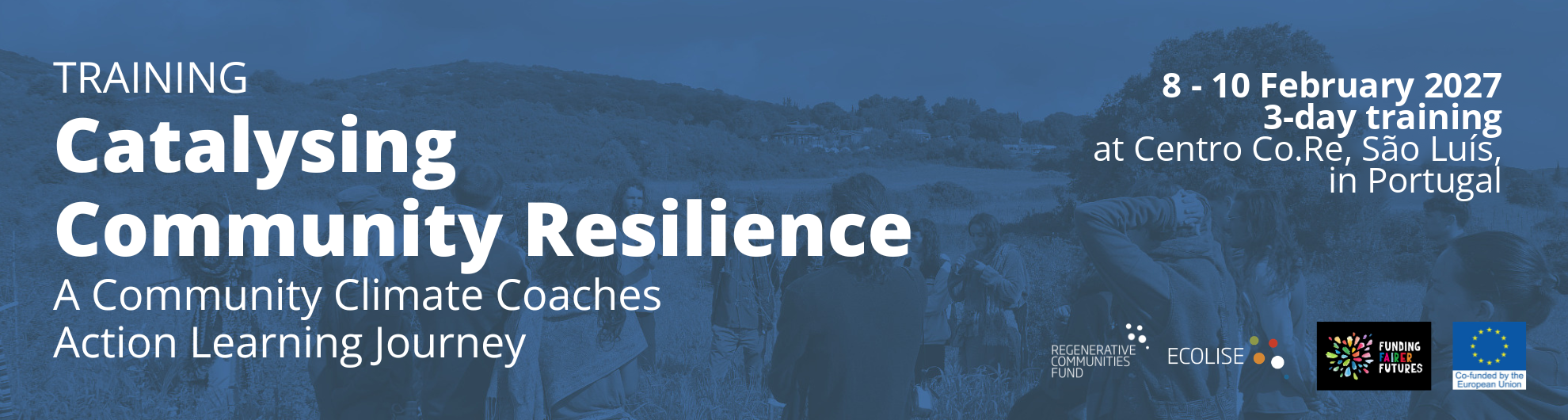
Catalysing Community Resilience: A Community Climate Coaches Learning Journey
This action learning journey is designed to support local communities in deepening their capacity to steward regenerative transformation within their territories. Building on the Community Climate Coaches (CCC) framework, the 3-day training invites participants to move beyond project delivery and into the realm of living systems stewardship, strengthening the inner, relational, strategic and governance capacities needed to navigate complexity, growth and systemic transition with integrity.
Grounded in regenerative practice, decoloniality and intersectionality, the learning journey explores how communities can cultivate more just, inclusive and life-affirming pathways for territorial resilience, environmental and climate action.
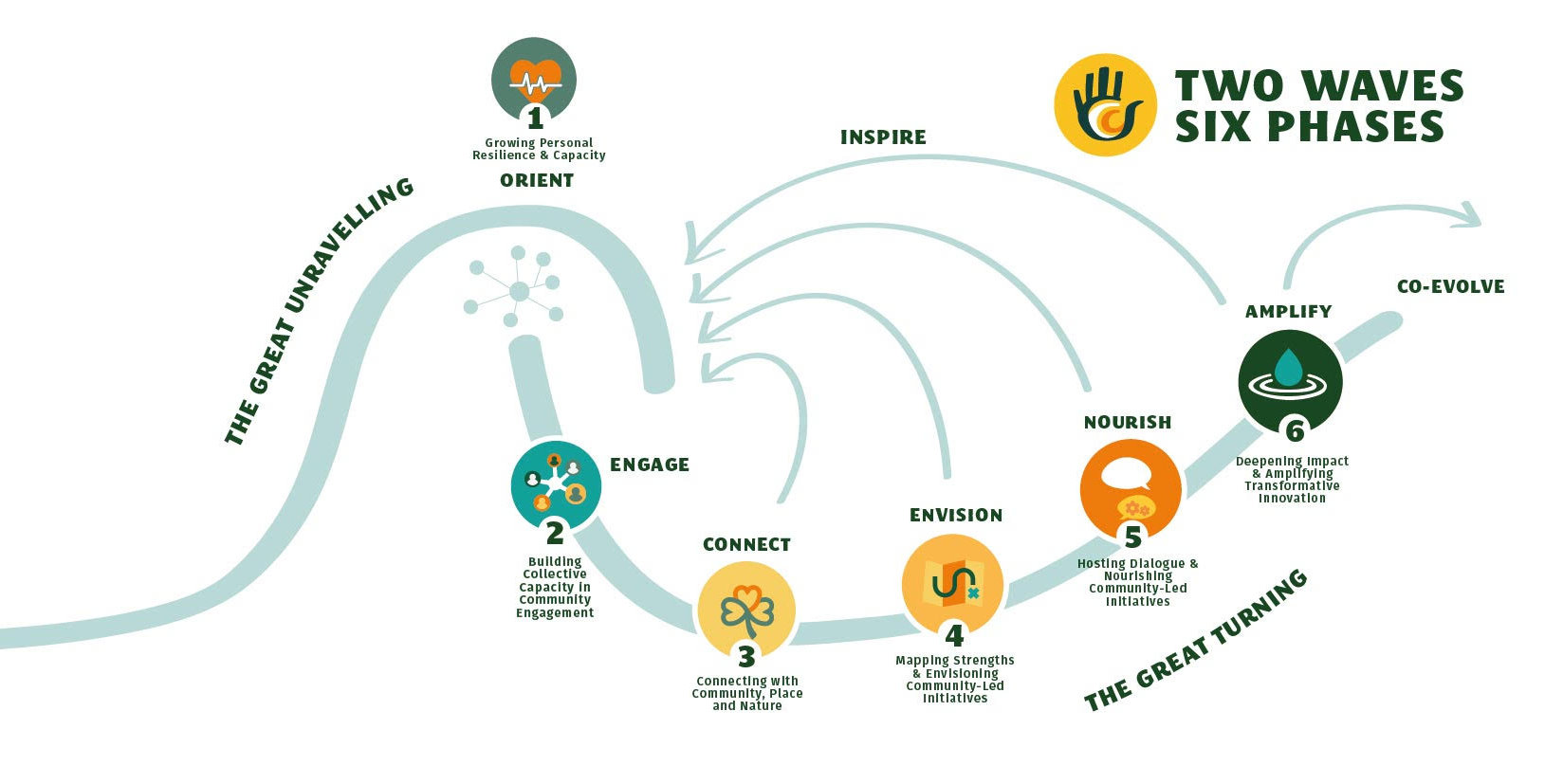
Through participatory, place-based and experiential methodologies, participants will deepen their capacities in community engagement, regenerative governance, facilitation, systems analysis and strategic action, while exploring the CCC Two Waves & Six Phases learning pathway. Together, we will cultivate spaces for co-learning, reflection and cross-pollination that strengthen communities’ ability to nurture resilient, just and regenerative futures grounded in the uniqueness of place.
Action Learning Journey
Phase 1: Pre-training activation (December 2026 – January 2027)
We provide a pre-training activation phase to understand your community’s development stage and potentials through a short CCC-aligned self-assessment. Moreover, we invite you (all participants) to join one online preparatory 1.5 hour session happening on 25 or 26 of January to connect with the trainers, purpose and content – and start this learning journey together. Please share your availability during registration for scheduling the session.
Phase 2: in-person 3-day training (from 8-10 February 2027)
Overall Purpose: To strengthen the RCF ecosystem’s ability to draw inspiration and direction from the unique character and potential of each community’s place, deepen its understanding of how living systems thrive, and build the skills and confidence to spark and sustain lasting community-led regeneration.
Learning Journey:
- Day 1 – Grounding Regenerative Power: Strengthening personal and collective agency and decision-making through exploring communities as living systems, regenerative development paradigms and adaptive change. Moving beyond reactive responses and external dependencies, participants will learn how to recognise and take responsibility for their capacity to catalyse regeneration.
- Day 2 – Sensing into Place & Deepening Relationships: Expanding our awareness beyond individual and organisational interests to embrace the interdependencies of communities, territories and ecosystems. Through place-based inquiry, storytelling, and explorations on intersectionality, participants will cultivate the capacity to recognise unique place potential and mutualise collective power.
- Day 3 – Stewarding Regenerative Futures: Shifting from individual and organisation-centred action towards ecosystemic agency, sourcing initiatives from the unique potential of place. Integrating systemic diagnosis, participatory planning and regenerative governance, participants will practise developing strategies and collective capacities that catalyse and sustain community-led regeneration.
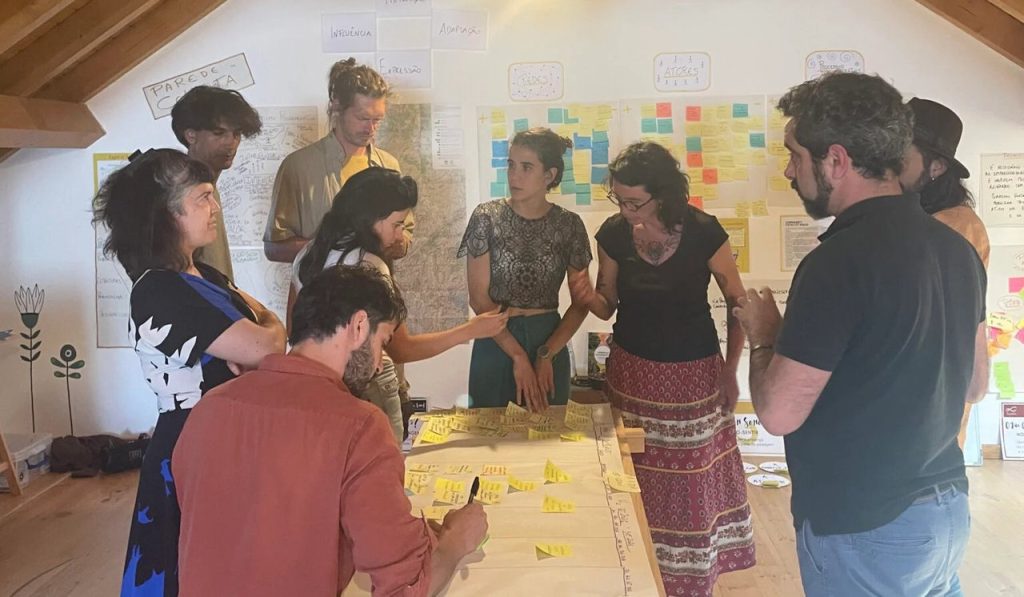
Methodologies include embodied living-systems exercises, regenerative development frameworks, place-source storytelling, participatory systems mapping, peer co-coaching, reflective inquiry and collaborative action planning.
Phase 3: Integration and mentoring (March to June 2027)
Post training, we will continue our collective learning journey with a focus on implementation, troubleshooting, and cross-pollination of learning including:
- Three online group mentoring sessions (2 hours each) using regenerative resourcing approaches (every 6–8 weeks)
- Learning peer buddy structures
- Shared resource and exchange space
This will strengthen RCF community leaders not only individually, but as a distributed European learning network.
Training format comprising access to the CCC online training and course platform for peer group engagement, one ‘preparing the ground’ online call (90 mins), 3 days of in-person training, three mentoring online calls (2 hours each), complemented by a training workbook.
When you register it is for the entire learning journey and you are expected to actively participate in all 3 phases (joining only the training is not possible).
What participants of the previous training say
“A collective dive into why and how we can develop further collective transformation into regenerative life listening to the call of our ecosystem.”
“A learning journey that changes you from within, to strengthen our capacity for transformation and to anticipate, here and now, the society of tomorrow.”
“I met people who work with a lot of heart and few resources, like us. It was good to know we are not alone. I also saw that the problems we have in Montserrat are the same in many places.”
“This is a platform for development where new methodologies and ways merge with ancient knowledge and wisdom. The program connects the past, present and future with clear goals of recovery and awakens deep respect for the whole - self, others and nature.”
“One of the most valuable aspects of the training was the opportunity to connect with other regenerative initiatives facing similar challenges. The experience helped us move beyond project thinking and focus on nurturing the relationships and capacities that make lasting transformation possible.”
“An experience that helps to open the mind and expand the concept of regeneration. Through this training, I discovered that we are not alone; sharing tools between communities helps us to grow.”
“The course content was diverse and engaging, and the facilitation was excellent. The trainers created an environment where the entire group participated with commitment and enthusiasm.”
“This training reminded me that regeneration begins by understanding the uniqueness and potential of place, rather than applying predetermined solutions. It has strengthened both my practice and my confidence to support communities in cultivating their own capacity for long-term stewardship and regeneration.”
“This training did more than give me tools: it shifted the perspective from which I look at our community, our territory and my own role within them. I leave deeply nourished, with new questions, strong connections and a renewed desire to help create the conditions for what is already wanting to emerge.”
Venue, Travel and Logistics
- Location: São Luís village in Portugal – main training venue Centro Co.re
- Host: Regenerativa Cooperativa Integral
- Dates: 8-10 February 2027 for a 3-day residential training
- Arrival: 7 February 6-8 pm (local Portugal time)
- Departure: 11 February 10-11 am (local Portugal time)
- Contact Email: laura.kaestele@ecolise.eu
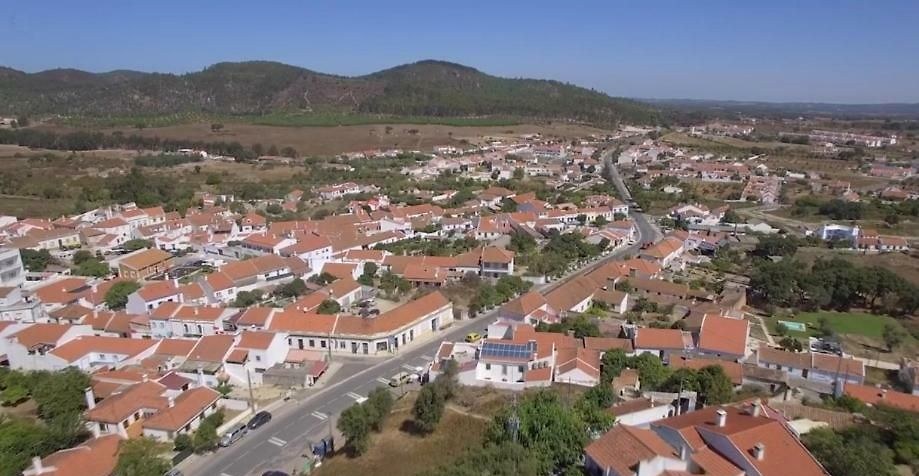
Village: In the golden hills of south-west Alentejo, where the River Mira runs through cork oak forests and along ancient paths, you’ll find São Luís – a village moulded by deep ecology, resilience and ancestral wisdom. Here, life followed the rhythm of the seasons: wheat, olive trees, medronho and cork sustained communities rooted in mutual help and hospitality. This rhythm has been interrupted – by monocultures, industrial agriculture and rural exodus. But São Luís endures, not as a relic, but as a beacon of the rural regeneration movement. Today, this bioregion pulses with renewal. Farmers, educators, artists and young people are returning to the land, reactivating its memory and its potential. Agroecology restores vitality to the soil. Alentejo singing continues to echo through the fields. The landscape invites us not just to visit – but to learn, collaborate and co-create the futures we need.
Venue: The training activities will be held at “Centro de Aprendizagem rural Co.Re”, which is equipped with a larger meeting room and all necessary equipment as well as a library and small kitchen for making tea, coffee and snacks for breaks. The garden is secluded and depending on weather some activities may be taking place outdoors. We will have multiple accommodation locations in the village with shared rooms of 2-6 beds for our group in Centro Co.Re, in Espaço Pinguim and Market House.
Participation and funding
We have 20-25 fully funded participation places available for this training, the main target group is RCF pathfinder communities who started in October 2026. Please apply via the registration form by 14 December and we will assess and possibly confirm your participation. For funded participants we can cover:
- Accommodation in shared rooms (4 nights) and 3 meals per day during the training
- Travel costs 150-300€ per person (depending on the country / distance)
- Meeting room facilities, trainer and interpreter costs are all covered by ECOLISE
Moreover, we have a commitment to make a minimum 50% of all funded participation places available for participants from marginalised groups such as disability, LGBTQI, indigenous peoples or ethnic, religious, cultural and linguistic minorities, referred to here as the Most Affected People and Areas (MAPA). If you belong to any one of those groups, please share with us as part of the training registration form.
If you are able to cover all or some of the costs related to the training participation and travel through your organisation, the RCF grant you receive or other means, kindly let us know when you register.
We welcome communities beyond the subgrantees of the Regenerative Communities Fund to apply and join the training covering costs of accommodation and food approx. 225-300€ (depending on room type) and travel expenses yourself. Please follow the same registration process and we will be in contact.
Our Trainers
This training is organised by ECOLISE and designed for local communities of the Regenerative Communities Fund, as part of the Funding Fairer Futures project. We work in partnership with our network members and co-developers of the Community Climate Coaches (CCC) framework: Resilience.Earth (Catalonia, Spain) who provide two trainers facilitating this action learning journey for & with you.
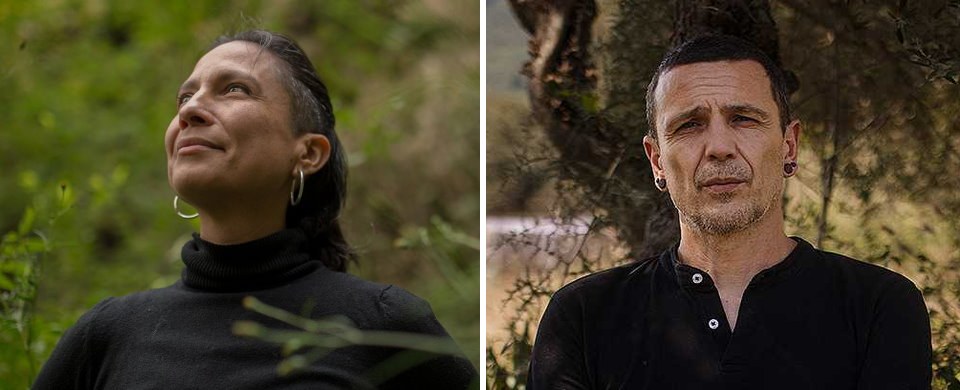
Erika Zárate is a Quechua-Canadian regenerative practitioner, facilitator and educator who accompanies communities, organisations and public institutions in navigating systemic transformation from a decolonial, intersectional and living systems perspective. She is co-founder of the Catalan cooperative Resilience.Earth and founding organisational member of Miceli.Social, a cooperative ecosystem dedicated to regeneration and transformative economies. Erika brings extensive experience in regenerative governance, community resilience, climate justice and participatory facilitation, weaving together developmental practice, place-based processes and bioregional regeneration to support communities in cultivating resilient and life-affirming futures.
Oscar Gussinyer is a designer, consultant and strategist who has been working for more than 30 years in the fields of sustainable development, systems thinking and co-creative and regenerative design, with a specialisation in rural areas, vulnerable communities and war zones. He is co-founder and member of several cooperatives and networks including the non-profit cooperative Resilience.Earth, the community centre Núria Social and the Iberian Permaculture Network and Iberian Permaculture Academy. His primary competencies are in regenerative development, design thinking, community and climate resilience, and change management. Òscar is also experienced in permaculture farming, bioconstruction and solar energy, having run a permaculture and bioconstruction cooperative for over a decade.
This event is co-funded by the EU DEAR project Funding Fairer Futures.

Location
Centro Co.Re
N120 16, 7630-174 São Luís (Odemira, Alentejo), Portugal
Public transport
You can reach Lisbon, Portugal by train, bus or airplane (if necessary) from other European countries. From Lisbon (Sete Rios) you can then take a direct bus to São Luis on Sunday for a 17:30 departure and arrival at 20:10 (local time). The direct bus from São Luis to Lisbon (Sete Rios) on Thursday departs at 10:15 in the village and arrives in Lisbon at 12:50 (local time).
If you travel from (and to) Faro or Sevilla you can take trains to a station called Santa Clara-Saboia 40 minutes away from São Luís. From the train station a taxi costs 40 Euros to get to São Luís. For all training participants we can organise shared taxis, car sharing and of course taking the bus from Lisbon together!