Scaling out Education & Sustainability Cooperation for Green Transition
Dissemination of results, tools, and learnings from the Tale project
The Erasmus+ funded project Tale – Transformative Adult Learning for Green Transition – is coming to its completion in November 2024. In the project adult learning education (ALE) organisations have engaged with learners, (urban) communities, and sustainable grassroots initiatives through collaborative “innovation groups” in six European countries (FI, DE, HU, AT, GR, CH). The goal was to co-create transformative and participatory action-learning processes and provide insights to scale out such prototypes, foster great cross-sector collaboration, and contribute to green transition.
Especially for education-focused organisations or community-led initiatives seeking cooperation with (adult) education institutions, the insights from the Tale project may be valuable and applicable. A key project output and results we want to share is a virtual toolkit as an interactive and visually engaging way to present case studies of the pilots implemented in 6 countries, methods used, key lessons learned during the project, published articles, podcasts, and descriptions of the cooperating grassroots initiatives.
Click here to open an accessible view of this content
Co-creation process and reflections of innovation groups
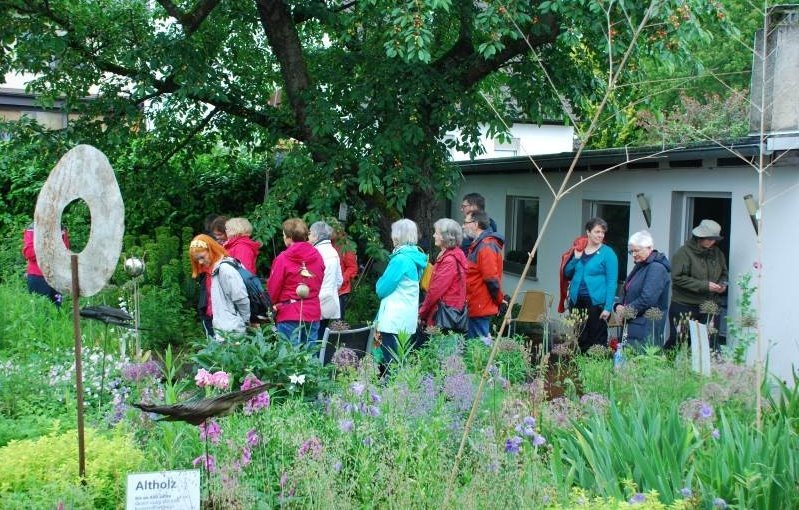
A collaborative approach developed and piloted during the Tale project is called “innovation groups” where cooperation between ALE institutions, adult learners, and grassroots sustainable initiatives is fostered to learn from each other, catalyse transformation, and gain awareness, capacities, and hands-on skills for a green transition. The innovation groups focused on sustainability issues such as nature protection, gardening, seed diversity, ethical consumption, circular economy, art, and climate action. You can find descriptions of the green initiatives and pilots in the virtual toolkit. The common approach was transformative action-learning, applying a co-creation design process, various participatory learning methods and reflection framework (learn more in this document).
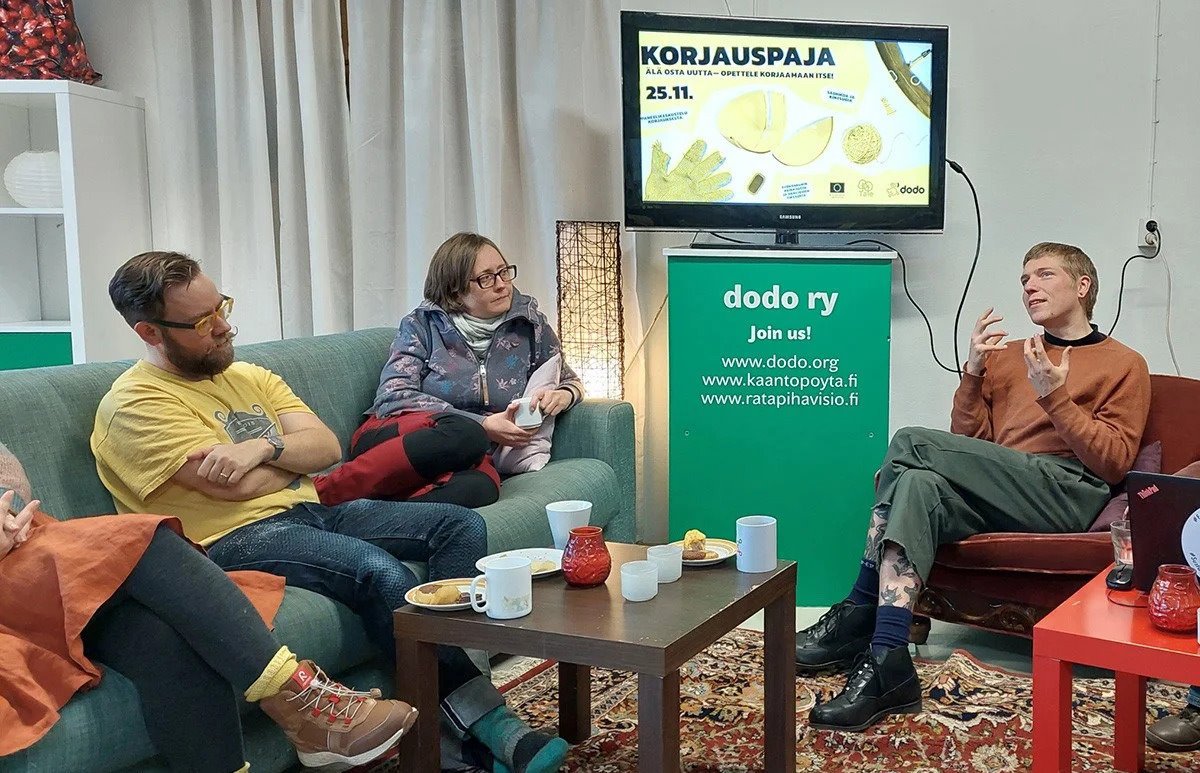
“With grassroots organisations the focus is on DOING. That is refreshing” reported a participant from the seed diversity workshop in Switzerland. As Marianne Müller, SVEB, Switzerland shared: “Transformative moments are hard to plan. But if you manage to create such a moment it is incredibly valuable”. It can be challenging to get learners involved in the learning and planning process or to attract a larger number of participants, especially new target groups. It takes persistence to build active engagement and unlearn conventional education methods and behaviours for people to be liberated and thus fully participate in a holistic learning experience. Overall, the cooperation was valuable in the words of Jonne Nurmela, from Dodo in Finland: “It is crucial to think outside the box, become multidisciplinary, and seek new ways to approach people and the topics. Collaboration between unexpected partners can be very fruitful.”
Inspiring dialogues between sustainable practitioners and educators
At the Tale project final event, Fergal Finnegan from the University of Maynooth (Ireland), one of the speakers joining a dialogue shared: “Insights from adult education on transformative learning are really solid. There are certain conditions to allow people to come exploratory. One needs to feel secure, and also feel like an agent. Learning moves in many directions in the room. It has to orientate itself towards praxis. Dialogue is an important part of that.”
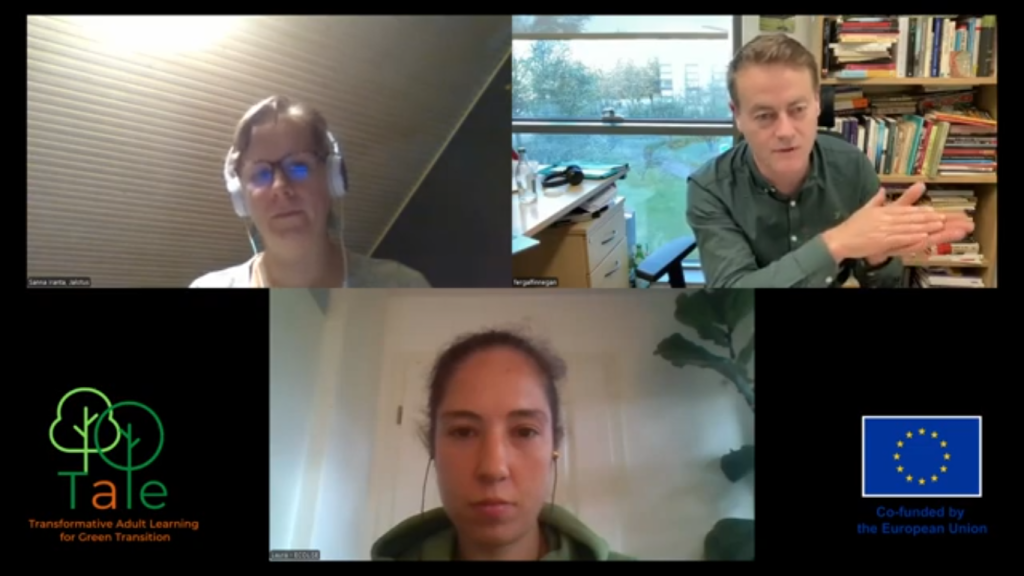
As part of the Tale project, we hosted several dialogues between sustainable practitioners, community-led initiatives or activists, and adult educators. This turned out to be very fruitful, inspiring, and rich in learning. In spring 2024, we hosted a three-part webinar series to showcase innovative practices, and expert insights, and foster discussions on how different stakeholders can work together for a more sustainable future. The topics included innovative educational approaches and practices to foster a green transition, community-led initiatives sharing about their activities for citizen participation and informal learning as well as the role of policy and research driving transformative learning and sustainable transition.
Sanna Iranta, from Jalotus (Finland) highlighted: “Peer support and emotional skills are important. People need to be able to discuss their emotions about climate change. This way you can also learn what may be the hindrances and limited thoughts for action. When you can express them, you are able to learn and get past them to act. We need to have hope in our lives, and we need to have a feeling that we can do things. That way we can have the strength to impact larger things in society.”
Recommendations for adult educators and policymakers
Based on the experiences gathered in the project, the partnership has compiled policy recommendations to foster successful cooperation between adult education organisations and green grassroots initiatives. On the one hand, these recommendations target policymakers and ask them to support and provide resources for community-based learning and the work of sustainable grassroots initiatives, to encourage active citizenship and community engagement, and to support holistic educational approaches and reflective assessment practices for transformative learning.
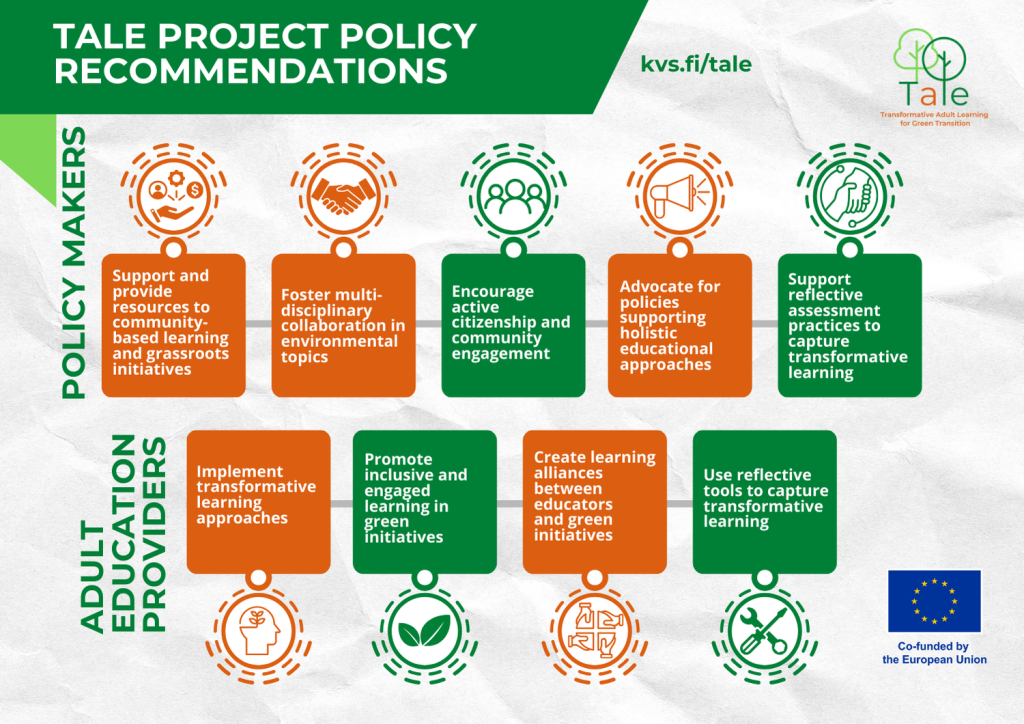
On the other hand, we recommend that adult education providers implement transformative action-learning approaches and methods, to create learning alliances and partnerships between educators and green grassroots initiatives, as well as to promote inclusive, participatory, peer-based, and action learning and reflective tools to capture transformative learning. We really encourage ALE institutions, community-led initiatives, policymakers, and active citizens alike to take inspiration and practical tools to apply from the Tale project to enable and scale out transformative learning for contributing to a just eco-social transition.