
From an Extinct Tradition to a Living Community: Regenerating Serra da Estrela through Flax
Written by: The Linho a fio team
In 2024, three people living in Portugal’s Serra da Estrela Natural Park decided that waiting for change was no longer an option. Their home, the country’s highest mountain range, had been deeply transformed by decades of rural abandonment, an ageing population, the loss of traditional livelihoods and poor spatial planning. Two devastating wildfires, in 2017 and 2022, had left an unmistakable message: the landscape had become increasingly vulnerable, and the social fabric that had once cared for it was steadily disappearing.
Instead of asking what had been lost, they asked a different question: what if an ancient tradition could become part of the solution? Their answer was flax. Less than a century ago, flax was woven into everyday life across Serra da Estrela. Families cultivated it, processed the fibre together and transformed it into linen, creating not only textiles, seeds, oil and fishing nets, but also knowledge, relationships and a strong sense of community. Over time, the emergence of other fibres, together with rural depopulation, caused this biocultural heritage to disappear completely. For almost eighty years, flax had not been cultivated in the region.
Bringing it back proved far more challenging than anyone had expected. Traditional flax varieties had disappeared locally and were difficult to obtain anywhere in Portugal and Galicia, Spain. The tools required to process the fibre had fallen into disuse or no longer existed. Most importantly, the practical knowledge of growing, harvesting and transforming flax had almost vanished from the region. The first step was therefore not to cultivate the land, but to recover knowledge and reintroduce traditional flax varieties that are better adapted to local conditions and more resilient to climate change.
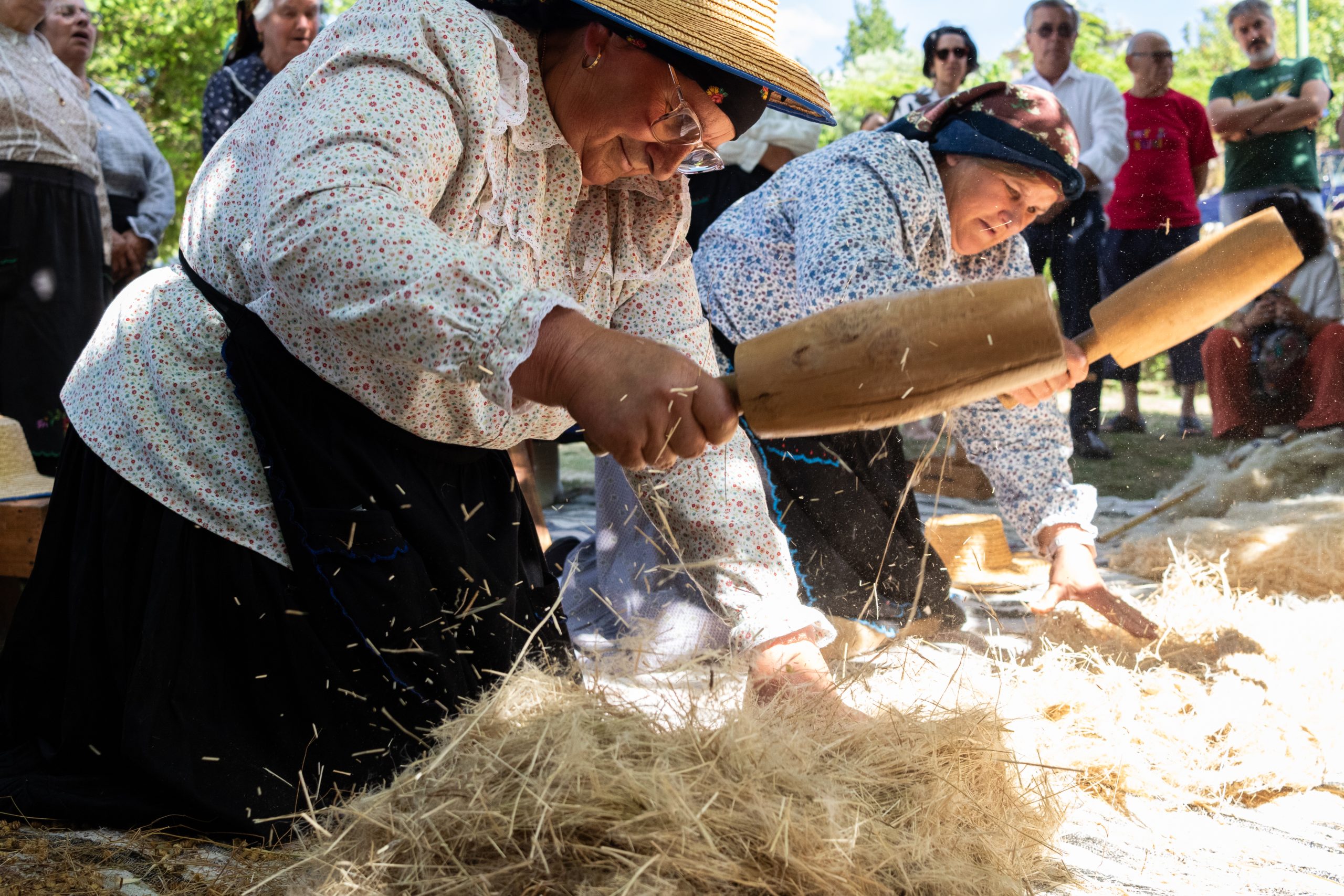
Seeds were sourced from the Portuguese National Seed Bank and from elderly farmers in northern Portugal who have continued cultivating flax over the years to preserve these traditional varieties. The team travelled to northern Portugal to learn from some of the last people who still preserve this tradition, many of them connected to local folklore associations that continue demonstrating historical flax processing techniques. They complemented these exchanges with the digital flax cultivation and fibre processing course developed by Saber Fazer, gradually rebuilding a knowledge system that had almost been forgotten.
From this learning journey emerged Linho a Fio, a community initiative with an ambitious vision: to restore the complete flax cycle as a catalyst for ecological, cultural and social regeneration. More than reviving a forgotten crop, Linho a Fio seeks to rebuild the social fabric around a shared landscape, where people become active stewards of both nature and cultural heritage. And to turn this vision into reality, the project received the indispensable support of Palombar, which, far more than a host institution, became a fundamental partner in shaping, supporting and making the initiative possible.
The project supports local people who wish to cultivate flax by providing practical assistance with land preparation, fertilisation, access to seeds and tools and technical guidance. By bringing abandoned land back into cultivation, the initiative also contributes to creating a more diverse and less fire-prone landscapewhile opening new opportunities for local entrepreneurship, particularly for young people, women and newcomers to the region.
Equally important, Linho a Fio aims to restore something less tangible but just as valuable: the relationships between people, landscape and culture. This vision expanded and moved to collective action in June 2026, when the project partnered with the Municipality of Celorico da Beira to organize the Flax Fest. Over three days, local residents, artisans, farmers, researchers and visitors gathered to rediscover a tradition that many had only heard about from their grandparents. Practical workshops demonstrated every stage of the flax cycle, from cultivation to fibre processing, creating rare moments of intergenerational exchange where knowledge was passed directly from older to younger generations. For many participants, it was the first time they had seen these techniques practised outside family memories.
The festival also created space for dialogue. A roundtable discussion brought together different perspectives to reflect on the challenges facing Serra da Estrela and to explore how rural activities rooted in local heritage can contribute to the regeneration of both landscapes and communities. Music, textile art and cultural performances celebrated flax not simply as a crop, but as a symbol of identity, resilience and creativity.
Perhaps the festival’s greatest achievement was not the number of participants, but what happened afterwards. For the first time in generations, people were not simply remembering flax — they were asking how they could grow it, learn the forgotten skills and become part of the movement. What had started with three people was becoming a collective movement.
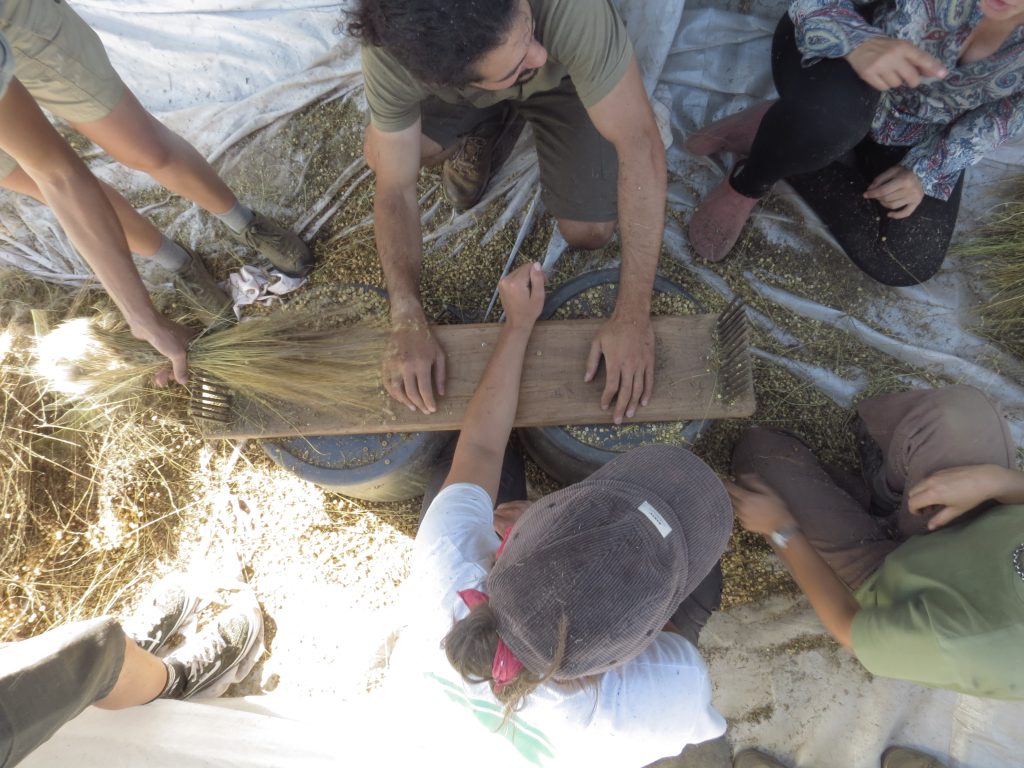
The project’s success will not be measured by the number of hectares cultivated, but by the number of people who choose to care for the landscape together. The next challenge is to support this emerging network. Making flax cultivation accessible requires shared native seeds, tools, collaborative workspaces and opportunities for learning together. While some traditional tools are already being reproduced by local craftspeople, others, such as the historic flax-processing machinery, have disappeared entirely. Recreating these technologies is now one of the project’s aspirations, helping reduce the physical demands of processing while making the entire flax cycle accessible to more people.
For the Linho a Fio community, flax is no longer simply a fibre—it has become a way of bringing people back together renewing their land, recovering forgotten knowledge, reducing wildfire risk and imagining a different future for Serra da Estrela—one where ecological restoration and community regeneration grow together.It has become a way of reconnecting people with their land, recovering forgotten knowledge, reducing wildfire risk and imagining a different future for Serra da Estrela—one where ecological restoration and community regeneration grow together, thread by thread.
The next chapter of this journey is being made possible through the support of the ECOLISE Funding Programme, which is helping transform a local initiative into a growing community of practice. By strengthening collaboration, knowledge exchange and citizen-led action, this support enables Linho a Fio to continue restoring not only an ancient crop, but also the relationships that sustain resilient landscapes and thriving rural communities. After almost eighty years of silence, flax is once again weaving people, nature and culture together in Serra da Estrela, showing that the strongest threads for the future are woven through the strength of community.