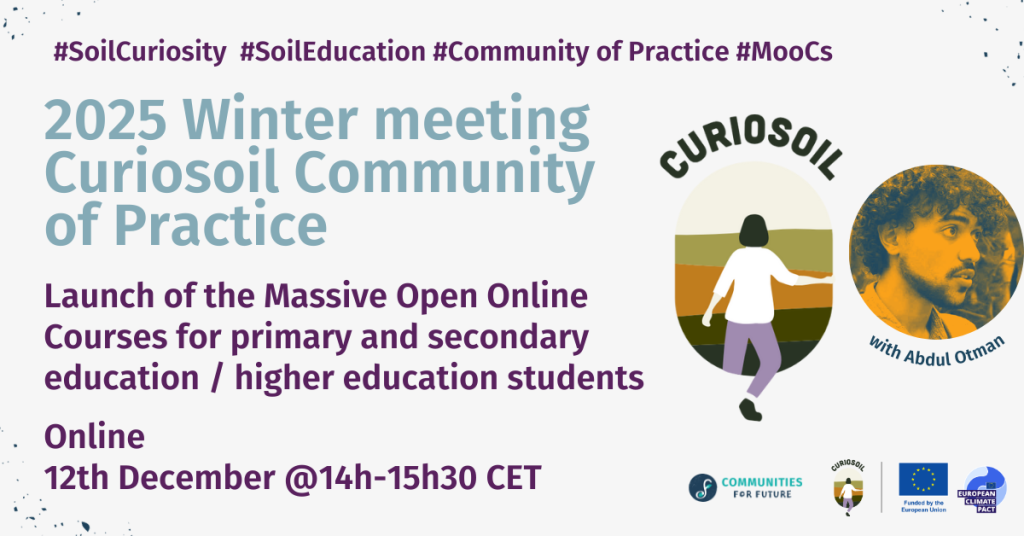
2025 Winter CURIOSOIL Community of Practice
The Winter 2025 meeting of the CURIOSOIL Community of Practice (CoP) brought together soil educators, practitioners, communicators, and researchers from across Europe to take stock of progress and align on next steps for piloting, testing, and scaling CURIOSOIL tools in the coming months. The session combined practical clarifications with an open exchange of resources and ideas, reinforcing the collaborative spirit at the heart of the project.
The CURIOSOIL Community of Practice (CoP) brought together soil educators, scientists, and policy advocates from across Europe. The CURIOSOIL project, spearheaded by University of Aveiro (Portugal), aims to foster soil literacy through innovative educational tools and collaborative efforts among diverse stakeholders. This inaugural event marked a significant step toward soil educators engagement with the activities of the project.
Resources from the session:
- The slides presented
- The link to join the CURIOSOIL MooC pilot phase
- The invitation for the 2026 Spring CURIOSOIL Community of Practice on 3rd March 2026
- The resources already included in the CURIOSOIL website for inspiration: Curiosity Kit – CURIOSOIL
- The feedback Survey of the World Soil Museum App as well as the QR code to access it through your phone.
- Decolonising Soil Series Wrapped Up
- The official source for project videos is the CURIOSOIL Video Wiki: https://curiosoil.eu/curiosity-kit/video-wiki/.
- The documentary Onder het Maaiveld (Beneath the Surface), which features highly relevant images, was shared as an additional resource: https://www.onderhetmaaiveldfilm.nl/.
- The Soils Turn Book: https://ecoartspace.org/Sys/Store/Products/393225.
- Field to Palette: Dialogues on Soil and Art: https://www.routledge.com/Field-to-Palette-Dialogues-on-Soil-and-Art-in-the-Anthropocene/Toland-Noller-Wessolek/p/book/9781138297456.
- Bodem Buik Brein (Soil Gut Brain): Glashouwer Theaterproducties’ performance, presented by Dette Glashouwer and musician Joop van Brakel, explores the profound connection between the ‘BOTTOM/SOIL’, our ‘BELLY’, and our ‘BRAIN’. The theatrical and humorous piece delves into the importance of microbes, noting that a handful of healthy soil contains as many living creatures (microbes) as there are people on Earth. The show features two performers with “30,000 billion extras” (microbes) each, making humanity’s connection with its soil tangible. The accompanying website is: www.detteglashouwer.com/bodem buik brein.
- The recording below:
Be sure to follow our CURIOSOIL LinkedIn page and subscribe to our LinkedIn CURIOSOIL Newsletter.
Introduction to the CURIOSOIL Project
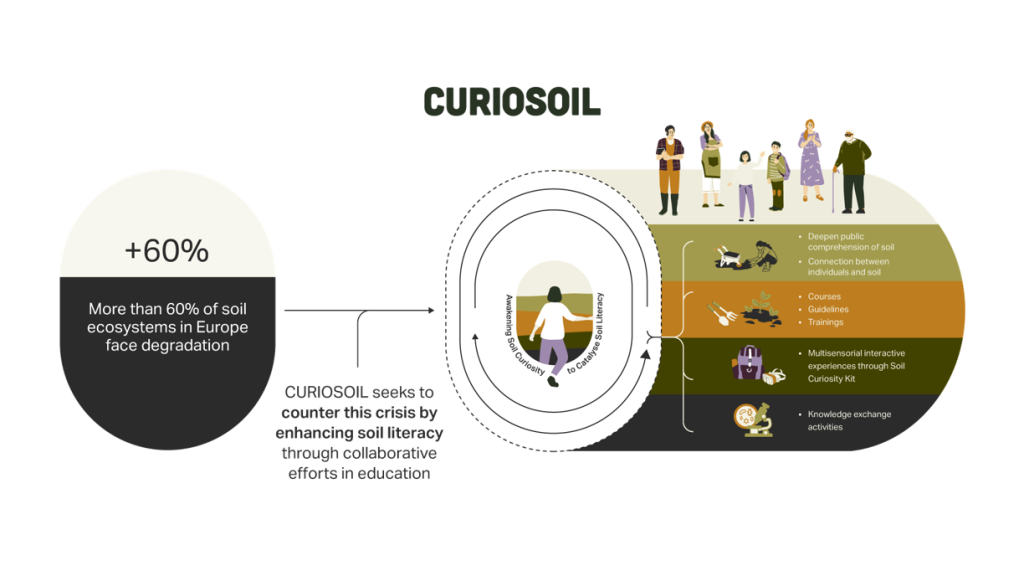
By collaboratively developing educational products, curriculum standards, and teacher training programs, CURIOSOIL aims to increase the appreciation of soil value and to align with the EU Mission “A Soil Deal for Europe.” This initiative cultivates soil literacy, engages citizens, and promotes sustainable soil practices. The project aims to integrate soil health into EU school curricula by 2030, fostering awareness, knowledge, and behavioural changes for a resilient and climate-smart future.
Running from 2024 to 2028, the project emphasizes different priorities each year. Benefits of participation in the Community of practice include early access to educational materials and financial support for national events. Indeed, a key workpackage “Engaging educational public authorities, policy and decision-makers” will deliver:
- 15 National workshops for the co-creation of recommendations for policymakers with a target attendance of >100 school and university heads
- 1 EU Final Conference with 100+ stakeholders and education policymakers
- 15 National and 1 EU policy briefs with recommendations for policymakers co-developed with school heads and education policy stakeholders
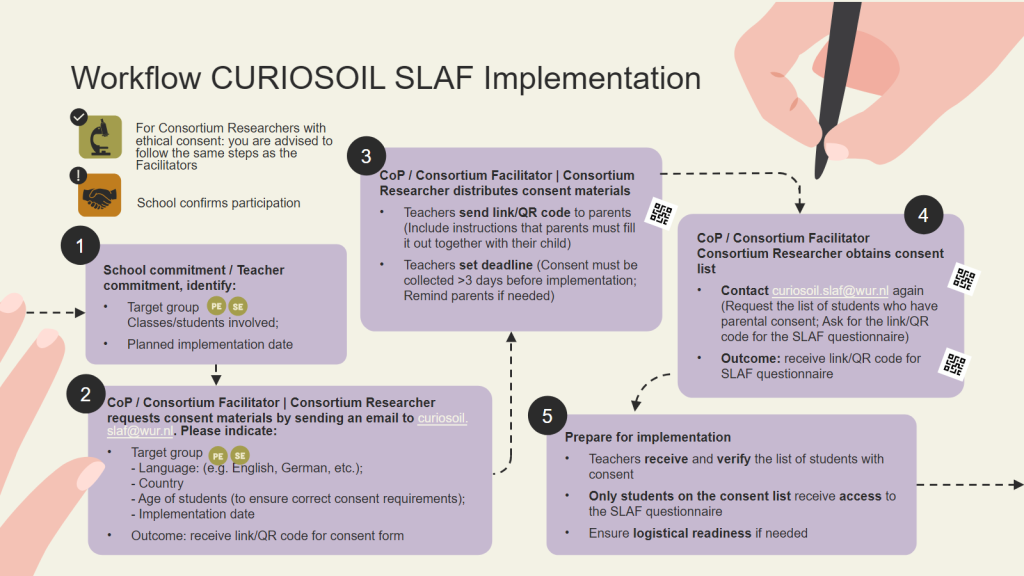
From piloting to practice: clarifying the rollout of Soil Assessment Framework
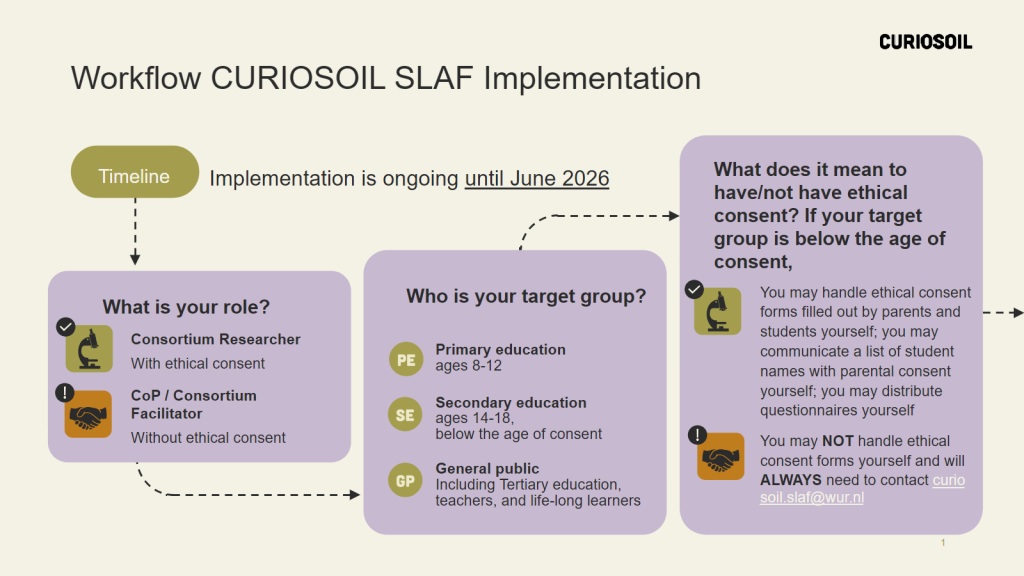
A central focus of the discussion was the practical rollout of CURIOSOIL tools, particularly the Soil Literacy Assessment questionnaires and their integration into school and community settings. Participants raised detailed questions about consent procedures, digital access requirements, and data handling. Clarifications were provided on how to proceed if individual students lack consent, ensuring ethical data use while maintaining flexibility for educators.
What is the Soil Literacy Assessment Framework?
The Soil Literacy Assessment Framework is a multidimensional assessment tool that measures soil literacy beyond factual knowledge. It recognises that soil literacy involves a combination of:
- Understanding soil systems and functions
- Attitudes and values toward soil
- Behaviours and intentions related to soil care and stewardship
By addressing these dimensions together, the framework captures both learning outcomes and transformative potential, aligning with CURIOSOIL’s mission to awaken soil curiosity and support long-term behavioural change.
Target groups and flexibility
The Soil Literacy Assessment Framework is designed for use across multiple audiences, including:
- Primary & Secondary education
- Young people aged 14+ and the general public
Rather than enforcing rigid age boundaries, the framework allows for educator judgement and contextual adaptation. This flexibility acknowledges differences in educational systems across countries and ensures the tool remains usable in real-world settings.
Role within the CURIOSOIL project
Within CURIOSOIL, the Soil Literacy Assessment Framework serves multiple purposes:
- Establishing baseline levels of soil literacy
- Monitoring change over time as participants engage with CURIOSOIL tools
- Generating evidence to inform educational practice and policy recommendations
By linking grassroots learning activities with structured assessment, the framework helps translate local experiences into European-level insights aligned with the EU Mission “A Soil Deal for Europe”.
Why the framework matters
The Soil Literacy Assessment Framework provides more than measurement—it offers a way to:
- Understand how people connect with soil
- Improve the design of educational tools and activities
- Strengthen the evidence base for soil education policy
By balancing scientific rigour, ethical responsibility, and practical usability, the framework supports a holistic approach to soil literacy, helping ensure that curiosity about soil can grow into lasting care and action.
A new educator’s MOOC is in development
A new online course for educators is currently in development, designed to support soil literacy across formal and non-formal learning contexts. The MOOC will feature tailored learning modules, interactive elements, and gamification, allowing educators to engage with soil topics in a flexible and motivating way. Built-in feedback mechanisms will enable both learners and the project team to reflect on usability, clarity, and relevance.
Community members are invited to test the MOOC by mid-January, playing an active role in refining the content before wider dissemination. This testing phase will directly inform improvements ahead of translation into multiple languages and a planned public launch in February. By involving educators early, the course is being shaped as a practical, user-centred resource rather than a one-size-fits-all training offer.
The “Women Root for Soil” campaign
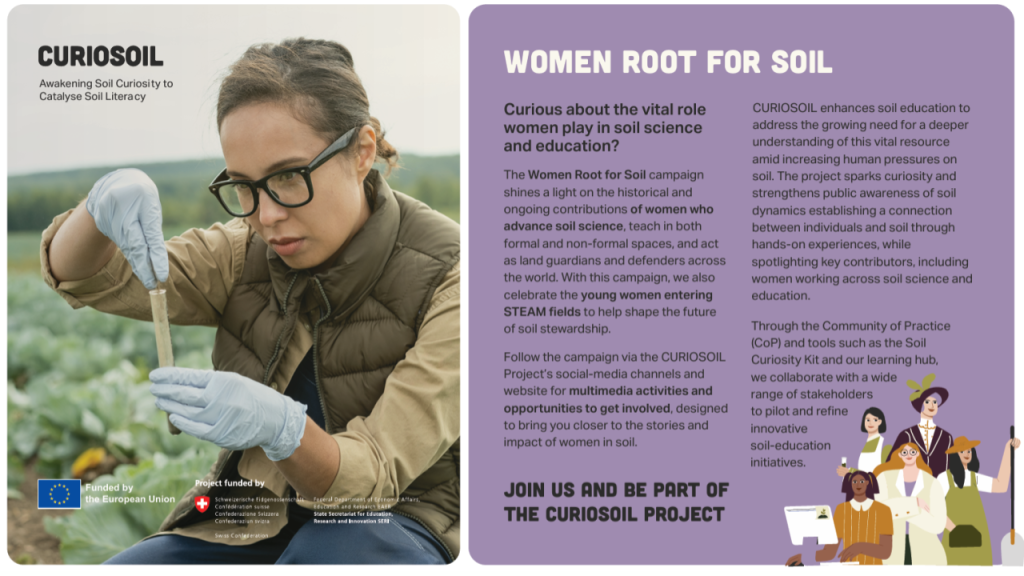
Running from mid-January to mid-June 2026, the upcoming Women Root for Soil campaign will highlight the often-overlooked contributions of women to soil science, education, and STEAM fields. The campaign brings together historical figures and contemporary researchers, educators, artists, and communicators, presenting soil knowledge as both scientific and cultural.
The campaign will feature a mix of videos, quizzes, and interactive content, designed to engage diverse audiences while challenging persistent gender imbalances in how soil expertise is represented. By foregrounding women’s work across disciplines, the campaign aims to inspire learners and practitioners alike, while expanding the narratives through which soil literacy is communicated.
World Soil Museum App
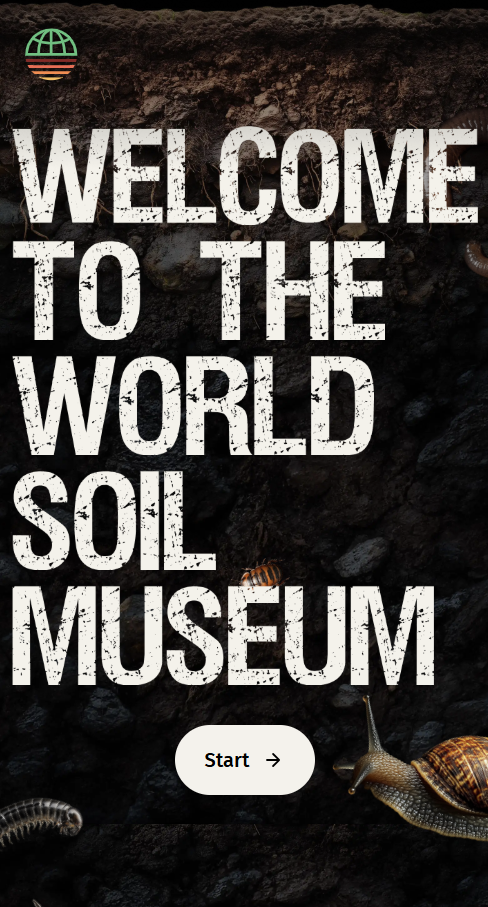
The meeting also previewed the launch of the CURIOSOIL App, offering a virtual tour of the World Soil Museum. The World Sound Museum App is taking shape as an immersive learning tool that introduces soil through sound, story, and multisensory exploration. Designed for both children and adults, the app combines audio narratives, visuals, quizzes, and 3D elements to create engaging pathways into soil knowledge.
Rather than presenting soil as an abstract scientific object, the app situates it within lived environments and landscapes, encouraging curiosity and emotional connection. As development progresses, the app is expected to become a key entry point for informal learning, complementing classroom activities and online resources.
You can click here to find the feedback Survey of the World Soil Museum App as well as the QR code to access it through your phone.
National workshops for co-creation of recommendations for soil education, by the International Union for Conservation of Nature
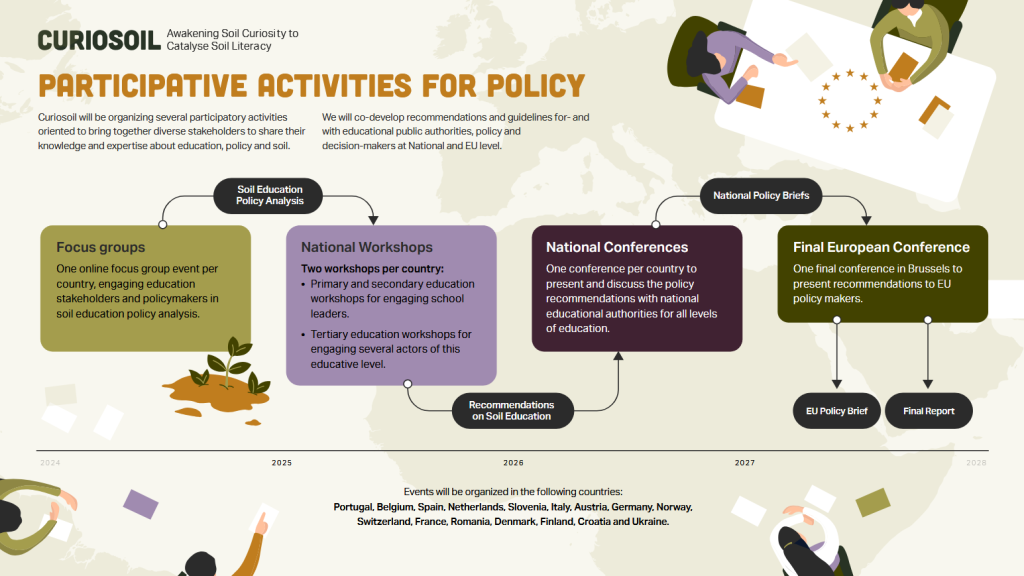
Looking ahead, Alberto introduced the CURIOSOIL National Workshops. Indeed, we will be organising a series of workshops across Europe to support the development of policy recommendations for soil education. These workshops will engage stakeholders from primary, secondary, and tertiary education in meaningful dialogues to inform future strategies.
The workshops will provide an opportunity to:
- Examine existing soil education policies and identify current needs and challenges,
- Share and highlight effective educational tools and practices,
- Co-develop recommendations for the integration of soil education into national policies.
The workshops will take place between October 2025 and April 2026.
These workshops will engage stakeholders in 15 countries to co-create policy recommendations on soil education. Structured around SWOT analyses, resource-sharing, and targeted policy discussions, they will culminate in national briefs and feed into EU-wide dialogue. For many participants, this represents a crucial avenue to link classroom practice with systemic change in education policy.
We would also like to highlight collaboration opportunities with the LOESS project, Literacy Boost through an Operational Educational Ecosystem of Societal Actors on Soil Health, and the potential learnings through the various Mission Soil and soil health-related projects:
You can read about these and all projects related to Mission Soil in their list.
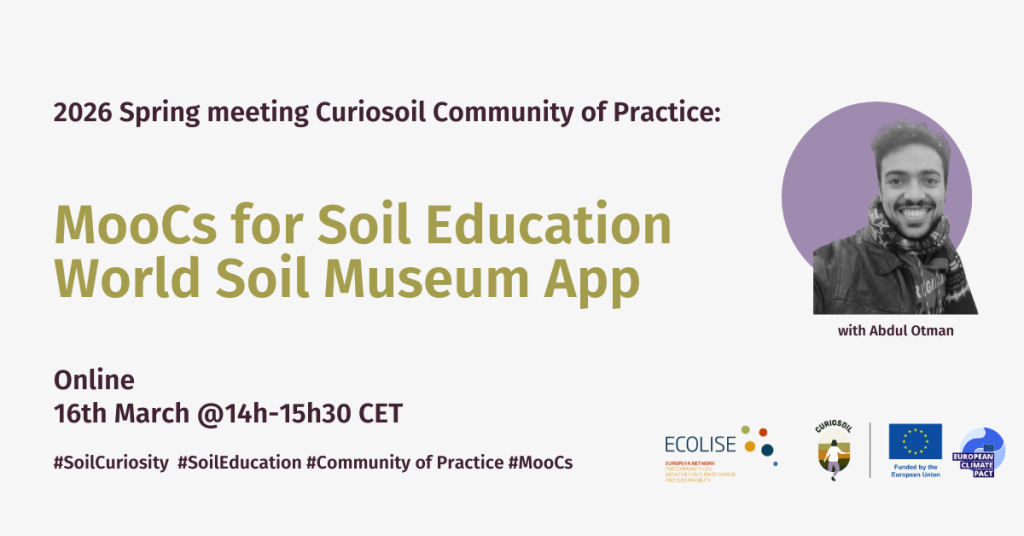
Invitation to CURIOSOIL’s 2026 Spring COP meeting
The next transnational meeting is scheduled for 3rd of March 2025, register now.
Be sure to follow our CURIOSOIL LinkedIn page and subscribe to our LinkedIn CURIOSOIL Newsletter.