2024 Winter meeting of CURIOSOIL’s Community of Practice: Strengthening national CoPs with CoP leaders!
The final Community of Practice (CoP) session for 2024, led by Abdul Otman, Coordinator of the CURIOSOIL CoP initiative, marked a culmination of the year’s collaborative efforts. This session highlighted the project’s milestones, engagement strategies, and opportunities for participants to deepen their involvement in the CoP framework.
The CURIOSOIL Community of Practice (CoP) brought together soil educators, scientists, and policy advocates from across Europe. The CURIOSOIL project, spearheaded by University of Aveiro (Portugal), aims to foster soil literacy through innovative educational tools and collaborative efforts among diverse stakeholders. This inaugural event marked a significant step toward soil educators engagement with the activities of the project.
Resources from the session:
- The slides presented
- Join the Why I Teach Soil Communication Campaign
- Opportunity to evaluate the Soil Assessment questionnaire for Primary education here. Please send your feedback to: nafiseh.taghizadehkerman@wur.nl and ingrid.lubbers@wur.nl
- Invitation for the Training: Best Practice Videos & Interviews Shot with Your Cell Phone 29/01/2025
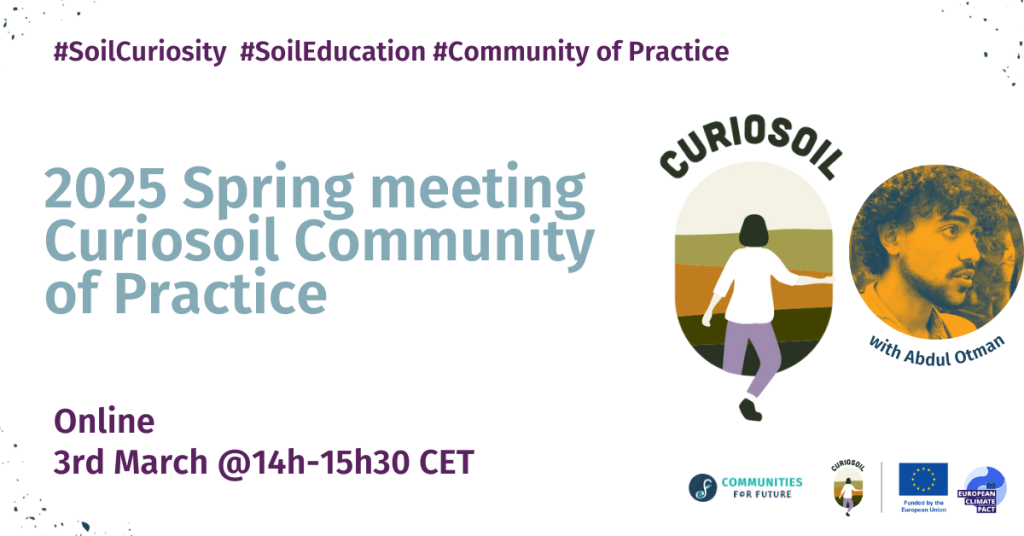
- Invitation for the 2025 Spring meeting of CURIOSOIL Community of Practice on 3rd/03/2025
- The recording below:
Be sure to follow our CURIOSOIL LinkedIn page and subscribe to our LinkedIn CURIOSOIL Newsletter.
Introduction to the CURIOSOIL Project
By collaboratively developing educational products, curriculum standards, and teacher training programs, CURIOSOIL aims to increase the appreciation of soil value and to align with the EU Mission “A Soil Deal for Europe.” This initiative cultivates soil literacy, engages citizens, and promotes sustainable soil practices. The project aims to integrate soil health into EU school curricula by 2030, fostering awareness, knowledge, and behavioural changes for a resilient and climate-smart future.
Running from 2024 to 2028, the project emphasizes different priorities each year. Benefits of participation in the Community of practice include early access to educational materials and financial support for national events. Indeed, a key work package “Engaging educational public authorities, policy and decision-makers” will deliver:
- 15 National workshops for the co-creation of recommendations for policymakers with a target attendance of >100 school and university heads
- 1 EU Final Conference with 100+ stakeholders and education policymakers
- 15 National and 1 EU policy briefs with recommendations for policymakers co-developed with school heads and education policy stakeholders
Why I Teach Soil Campaign Presentation

The “Why I Teach Soil” campaign is a cornerstone initiative aimed at raising awareness about soil health and promoting soil literacy among educators and their students. Presented by Nazih Toubal (REVOLVE) during the session, the campaign targets teachers and head teachers, emphasizing their pivotal role in fostering curiosity and understanding about soil. The campaign offers free, accessible educational materials designed to integrate seamlessly into school curricula. These materials, available on the CURIOSOIL website, have received great enthusiasm from the attendance, and include:
- Videos with quotes from the partners talking about Soil
- Visuals, infographics free to use with your students
- Social media quizzes for LinkedIn and IG to make soil literacy more fun to your students
- Educational materials (a beta version of the Curiosity Kit) with resources for teachers (relevant teaching materials: video courses, resources, glossary…), with a redirection to our website for exclusive content
- Translation of materials, quizzes available in CoP countries languages
- Certificates to distribute to students

A key feature is its inclusivity, with resources translated into multiple languages to eliminate language barriers and ensure accessibility for educators across all CoP countries.
The campaign’s strategy is built on a timeline that spans the academic year, starting with a social media teaser in December 2024, followed by its official launch during the winter CoP meeting. Nazih highlighted plans for engaging content, such as weekly updates, best practice videos, and interactive webinars for teachers. Special events, including midterm activities and field trips, will provide hands-on experiences that demonstrate the real-world applications of the campaign’s resources. Teachers and students will have opportunities to participate in soil-themed workshops and screenings of soil documentaries, further enhancing their learning experiences. By the end of the academic year, feedback from participants will guide the refinement of materials and the campaign’s overall impact.
Central to the campaign is the “Why I Teach Soil Toolkit”, which serves as a resource hub for educators. It features curated content such as partner quotes, educational videos, and an evolving beta version of the Soil Curiosity Kit. Teachers can share materials within their professional networks and contribute to content creation through photos, videos, and testimonials from pilot classes in their regions. To recognize efforts, certificates will be issued to students, celebrating their engagement with soil literacy. Through these multifaceted approaches, the campaign not only empowers educators but also cultivates a new generation of soil advocates, fostering long-term stewardship and sustainable practices within communities.
Apply here to join the campaign: https://forms.office.com/e/uHzQp4a2mT
Training: Best Practice Videos & Interviews Shot with Your Cell Phone” from the European Science Communication Institute (ESCI)
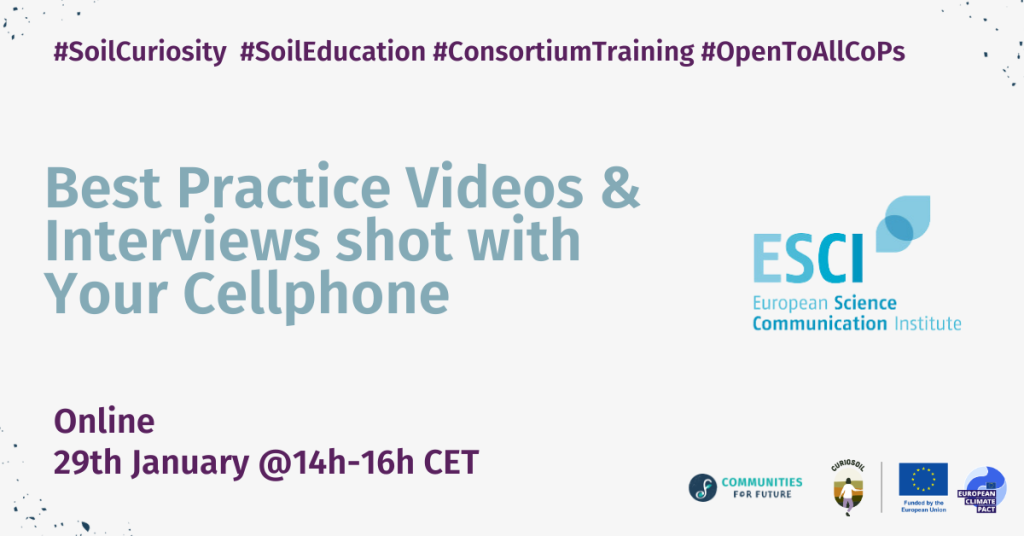
The “Training: Best Practice Videos & Interviews Shot with Your Cell Phone“ (29/01/2025), led by Ariane Bethusy-Huc from the European Science Communication Institute (ESCI), will provide participants with practical tools to create impactful video content using readily available technology. Ariane emphasized that videos are a crucial medium for communication, education, and community engagement. Recognizing that not all participants have access to professional video equipment, the training is designed to empower them with techniques for producing high-quality videos using their smartphones. Scheduled for January 29, 2025, this hands-on session will cover strategies for improving interview results, essential technical skills for filming, and affordable accessories to enhance production quality.
Ariane elaborated on the training objectives, which include enabling participants to document their activities, such as workshops, events, and hands-on educational sessions. These videos can serve multiple purposes, from enriching social media campaigns to contributing to Massive Open Online Courses (MOOCs) that highlight best practices in soil education. Ariane shared examples of compelling footage, such as educators conducting soil experiments, students engaged in gardening, and nonprofit workshops showcasing interactive learning. By equipping attendees with these skills, the training aims to amplify the reach and impact of soil literacy initiatives across the CoP network.
Ariane encouraged the community to leverage this opportunity to showcase their work and inspire others. By fostering a collaborative approach, the training not only enhances individual capacities but also strengthens the collective storytelling efforts of the CURIOSOIL project. Participants were encouraged to register for the session and reach out with specific questions or requests, ensuring that the training aligns with their unique needs and goals.
Register here for the Training: Best Practice Videos & Interviews Shot with Your Cell Phone.
Soil Literacy Assessment Framework (SLAF)
Led by Wageningen University, the Soil Literacy Assessment Framework is designed to assess attitudes and behaviours toward soil, aiming to improve soil awareness through educational programs, as well as assessing soil competences like Soil Functions, Soil Diversity, and Soil Health. Drawing from the PISA framework and GreenComp model, it will ensure a structured approach to understanding and promoting soil literacy. It will provide a baseline survey of soil literacy at primary, secondary and tertiary levels at the European scale.

The Assessment Framework will enhance the European sustainability competence framework (GreenComp) by integrating soil-related knowledge and skills for soil literacy assessment. This involves defining core soil literacy components, creating learning objectives, and incorporating them into GreenComp’s existing competence areas. The goal is to provide a standardized yet adaptable tool that educators, policymakers, and community leaders can use to assess knowledge, attitudes, and behaviours related to soil health and sustainability.
Development steps include a literature review, consultations with experts, and identifying soil competences for education programs. The Assessment Framework will also employ the Epistemic Curiosity Scale (ECS) to measure changes in soil curiosity over time, adapting methods to evaluate the effectiveness of soil education initiatives.
To support implementation, SLAF has outlined key domains—soil diversity, services, threats, and solutions—along with descriptive indicators and learning goals for each. Pilot testing in primary education has refined these tools, ensuring accessibility and clarity. During the CoP session, Nafiseh Taghizadeh Kerman presented the SLAF’s questionnaire, encouraging participants to provide feedback via a Mentimeter quiz.

This input is crucial for adapting the framework to real-world educational settings. As the framework evolves, it aims to bridge the gap between soil education theory and practice, fostering a generation equipped to sustain and restore soil health.
It will be rolled out to students, teachers, and the public, with the aim of gathering over 9,500 responses by 2025.
You can take a look and test the Primary education questionnaire here. We are welcoming feedback! Please send feedback to:
Synergies with Soil Mission projects: LivingSoiLL & CURIOSOIL

The LivingSoiLL Project is an ambitious initiative focused on promoting soil health in permanent crops through the establishment of Living Labs. Presented by Eriselda Canaj, the project spans six countries and runs from June 2024 to November 2028. It is supported by a consortium of 38 partners and 8 associated partners, representing diverse expertise in agriculture, education, and research. The project emphasizes five key permanent crops—vineyards, olives, chestnuts, hazelnuts, and apples—with Living Labs set up in Portugal, Italy, France, Poland, and Spain. Each lab collaborates with local stakeholders to develop region-specific strategies for soil conservation, restoration, and sustainable management.
Living Soil integrates practical and research-driven approaches to foster soil health. It aims to establish 15 experimental sites and 10 “lighthouses,” which serve as demonstration hubs for innovative practices. These locations actively engage farmers, researchers, advisors, and educators to co-create and test solutions. The work plan includes seven structured work packages, from governance and baseline research to communication and business model development. The project also seeks to improve soil literacy among various stakeholders and proposes policy recommendations for sustainable soil management practices. Through targeted workshops, field events, and webinars, Living Soil ensures knowledge dissemination and skill-building within its network.
The project’s Community of Practice (CoP) (click here to join the LivingSoill CoP), launched on the 1st December 2024, is a cornerstone of its outreach efforts. This CoP connects national and international stakeholders, fostering collaboration and knowledge sharing. Participants include farmers, educators, and researchers, who are encouraged to contribute via questionnaires available in six languages. The CoP hosts events and provides resources to strengthen soil stewardship practices. Living Soil complements CURIOSOIL by focusing on those directly interacting with soil, such as farmers, while CURIOSOIL bridges gaps for those not yet connected to soil. Together, these projects represent a holistic approach to fostering soil health, addressing diverse educational and agricultural needs.

We would also like to highlight collaboration opportunities with the LOESS project, Literacy Boost through an Operational Educational Ecosystem of Societal Actors on Soil Health, and the potential learnings through the various Mission Soil and soil health-related projects:
You can read about these and all projects related to Mission Soil in their list.
Looking Ahead – National CURIOSOIL Communities of Practice & CoP leaders
The evolution of the CURIOSOIL Community of Practice (CoP) structure marks a significant milestone, with the introduction of National CoP Leaders. During the session, Abdul Otman highlighted the shift from centralized, English-only meetings to a more localized and inclusive approach. This development follows the CoP Leader call launched in October 2024, which invited participants to apply for leadership roles within their respective countries. The primary goal of these leaders is to bridge the gap between the CURIOSOIL project and national communities, fostering greater engagement and tailoring initiatives to local contexts. By recruiting CoP Leaders, each representing a different country, the initiative ensures a decentralized and accessible format for collaboration.
These National CoP Leaders will play a pivotal role in piloting and validating educational materials developed under CURIOSOIL. They are tasked with organizing national-level events, workshops, and discussions in their native languages, thus encouraging participation from educators, stakeholders, and community members who might otherwise be excluded by language barriers. Acting as points of contact, these leaders will facilitate two-way communication, gathering feedback on materials and practices while disseminating resources and insights from the broader CURIOSOIL network. It was emphasized that this localized structure would enhance participation and empower communities to adapt resources to their unique educational and environmental needs.
The session concluded with national breakout rooms where participants had the opportunity to connect with their CoP Leaders, engage in discussions, and explore next steps for collaboration. For countries without representation at the session, participants remained in the main room for further engagement. The contacts of the National CoP Leaders were shared during the presentation, providing an open channel for ongoing communication. This evolution signifies a step toward more grassroots involvement, aiming to strengthen soil literacy efforts through place-based solutions and fostering a sense of ownership within local communities.
The next transnational meeting is scheduled for 3rd of March 2025, register now for the 2025 Spring meeting of CURIOSOIL Community of Practice
Be sure to follow our CURIOSOIL LinkedIn page and subscribe to our LinkedIn CURIOSOIL Newsletter.